
In 2026, wireless charging is moving beyond consumer electronics into robotics, electric vehicles, and compact connected devices. Evolving standards and new operating demands are reshaping how manufacturers develop and integrate wireless power systems.
Wireless Charging Is Moving Beyond Consumer Electronics
Wireless charging first became popular as a convenient alternative to cables. Today, its role is expanding as manufacturers explore contactless power for equipment with very different operating needs.
A warehouse robot might recharge between assignments, while a sealed sensor can operate without exposed charging connectors. Electric vehicles offer another possibility, although the power requirements are considerably higher.
Convenience remains part of the appeal, but it is no longer the whole story. Successful integration depends on available space, charging time, alignment, temperature, and the conditions each device encounters.
Qi2 25W Sets New Expectations for Consumer Charging
Consumer wireless charging continues to evolve, with Qi2 25W marking an important step forward. Introduced in July 2025, the specification increased standardized charging power while maintaining an emphasis on magnetic alignment and interoperability.
The market has responded quickly. Industry certification figures recorded more than 1,200 new Qi2 and Qi2 25W products during 2025, with compatible charging accessories also appearing at CES 2026.
Faster charging brings its own challenges. Higher power places additional demands on thermal management, foreign-object detection, and power regulation. Maintaining reliable performance throughout the charging cycle matters just as much as reaching peak output.
Miniature Wireless Charging Creates New Possibilities
At the other end of the market, smaller devices present a very different challenge. Smart rings, compact wearables, and connected sensors leave little room for conventional charging components.
NFC wireless charging offers one possible approach. The current Wireless Charging Specification 2.0 supports up to 1W, while the NFC Forum’s February 2026 roadmap explores a potential increase to 3W.
Making miniature charging practical requires decisions early in product development. Coil dimensions, magnetic materials, operating frequency, and component placement all influence what can fit inside a compact enclosure without compromising functionality.
Magnetic Resonance Supports More Flexible Charging Designs

Magnetic resonance charging is drawing interest where more flexible positioning is desirable. Like inductive charging, it relies on magnetic coupling, but tuned electrical networks play a particularly important role in system behavior.
Key Design Considerations
- Coil Geometry:Influences coupling strength and energy transfer efficiency.
- Circuit Tuning:Compensation networks and changing loads affect operating performance.
- Placement Flexibility:Larger charging areas require careful attention to coupling behavior.
- Power Control:Stable operation matters across the intended positioning range.
Multi-device charging and flexible charging surfaces remain promising applications. Still, greater distance or unrestricted placement cannot be assumed. The real-world performance is determined by the overall system design.
The Cordless Kitchen Demonstrates a New Direction for Wireless Power
Wireless power is not limited to charging batteries. The Ki Cordless Kitchen standard supports up to 2,200W of inductive power delivery, allowing compatible appliances to operate directly through specially equipped surfaces.
At CES 2026, several appliance concepts demonstrated this approach. Initial commercial products were expected to reach selected markets from late 2026, depending on development progress and launch schedules.
The idea goes beyond removing power cords from countertops. Integrating power into everyday surfaces introduces new requirements for electrical conversion, temperature management, communication, and safety, all of which must work together during normal use.
Industrial Automation Brings Wireless Charging into Daily Operations
Industrial robots and autonomous mobile vehicles often follow predictable routes, stopping at designated stations or between assignments. These pauses create opportunities to recharge without relying on manual cable connections.
With a properly designed docking system, charging can become part of an existing workflow. Commercial inductive charging systems already demonstrate how contactless power can support automated industrial equipment.
Of course, installation is only one part of the challenge. Charging duration, docking accuracy, battery communication, and safety systems all need to work reliably, even around metal structures and moving machinery.
For operators, the benefit is practical: less manual intervention and potentially better equipment availability. Whether those advantages justify the investment depends on system integration, maintenance requirements, and actual operating conditions.
Electric Vehicle Wireless Charging Moves Toward Commercial Adoption
Electric vehicle wireless charging is gradually moving closer to everyday use. Recent developments include an announced 11kW inductive charging option combining a ground-mounted transmitter with a receiver installed beneath an electric vehicle.
Such developments suggest growing commercial interest, although availability remains limited and conventional plug-in charging is still far more widespread across the automotive market.
Bringing wireless charging into vehicles requires careful engineering. Positioning accuracy, temperature control, and electromagnetic compatibility must meet demanding requirements. SAE J2954 provides a framework covering interoperability, safety, and performance testing for stationary light-duty EV charging.
Broader adoption will depend on installation costs, infrastructure, and vehicle compatibility. Commercial fleets and autonomous vehicles may find particular value in hands-free charging, although demand will develop differently across markets.
Far-Field RF Wireless Power Expands the Technology Landscape
Far-field RF takes a different approach to wireless energy transfer. Instead of relying on nearby coupled coils, it uses radiated electromagnetic waves that can be captured and converted into electrical power by a compatible receiver.
Its potential is particularly relevant to devices with modest or intermittent energy requirements.
- Potential Applications: Asset trackers, environmental sensors, and connected monitoring devices could benefit where small amounts of received energy support their operating cycles.
- Industry Progress:Regulatory approvals for enterprise wireless power transmitters during 2026 reflect continued efforts to bring RF-based energy transfer into practical IoT applications.
- Technical Challenges:Usable power depends on propagation losses, antenna characteristics, conversion efficiency, and regulatory limits. Detecting an RF signal does not necessarily mean enough energy is available.
Some devices may need to store received energy before performing a task. Commercial feasibility will continue to depend on realistic energy budgets and clearly defined operating conditions.
How Wireless Charging Standards Are Evolving
As wireless charging enters new markets, technical standards are becoming more important to product development. Different applications require different approaches to power delivery, interoperability, and safety.
Although these standards share the broad goal of wireless power transfer, they are not automatically compatible with one another.
Major Wireless Power Standards and Their Focus
| Standard | Primary Focus | Industry Significance |
| Qi2 | Consumer wireless charging | Magnetic alignment, interoperability, and standardized charging performance |
| NFC Wireless Charging | Miniature, low-power devices | Power transfer through compatible NFC systems |
| Ki Cordless Kitchen | Cordless kitchen appliances | High-power delivery to compatible appliances |
| SAE J2954 | Light-duty EV wireless charging | Vehicle interoperability, safety, and performance testing |
| IEC 61980 Series | EV wireless power transfer | System-level electrical and safety requirements |
Choosing the relevant standard early can save considerable redesign work later. A receiver developed for one specification may require different hardware, communication methods, or control strategies to support another.
Certification deserves equal attention. Compatibility with a technology does not automatically mean that the finished product meets every applicable requirement.
For engineering teams, standards are therefore becoming part of the initial design conversation rather than something to address only before market launch.
Where New Market Opportunities Are Emerging
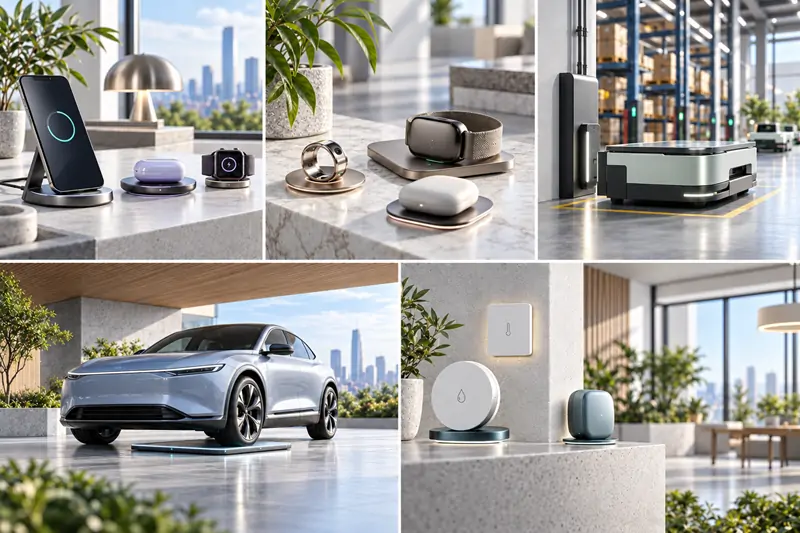
Wireless charging is opening possibilities across several industries, although the requirements and commercial priorities vary considerably.
The following overview highlights some of the opportunities and technical challenges associated with different application markets.
| Application Market | Emerging Opportunity | Main Engineering Challenge |
| Consumer Electronics | Higher-power, standardized charging | Thermal performance and interoperability |
| AI Wearables & Compact Devices | Miniaturized charging integration | Limited space and magnetic coupling |
| Industrial Robots & AGVs | Automated charging during operating cycles | Docking tolerance and charging availability |
| Electric Vehicles | Hands-free stationary charging | High-power efficiency, alignment, and safety |
| Low-Power IoT Devices | RF energy transfer and harvesting | Received energy and power management |
No single technology addresses all these requirements equally well. Some applications depend on close-range magnetic coupling, while others call for higher power, different positioning arrangements, or alternative transfer methods.
Ultimately, the most practical solution depends on what the device needs to do and the conditions in which it operates.
What B2B Manufacturers Need to Consider
Adding wireless charging to a product is rarely as simple as selecting a compatible module. The electrical system, physical structure, and intended operating environment all influence the final design.
Four areas deserve particular attention:
- System Architecture:Power requirements, circuit topology, and control behavior should be evaluated together rather than as separate design decisions.
- Magnetic & Receiver Design:Coil dimensions, shielding materials, and coupling characteristics need to suit the available space and surrounding components.
- Performance Validation:Charging efficiency, voltage stability, temperature, and alignment behavior must be checked under realistic operating conditions.
- Manufacturing Integration:Assembly methods, component selection, and production tolerances can influence whether a successful prototype performs consistently at scale.
From compact wearables to industrial robots, practical wireless charging calls for more than strong laboratory results. Integration costs, operating reliability, and application-specific validation all contribute to commercial success.
Looking Ahead: A More Application-Driven Wireless Charging Industry
Wireless charging in 2026 is progressing in several directions. Qi2 is improving consumer charging expectations, NFC is opening possibilities for smaller devices, and magnetic resonance continues to attract interest for flexible charging arrangements.
At the same time, industrial automation and electric vehicles are bringing contactless power into more demanding environments. Far-field RF offers possibilities for low-power electronics, although its commercial readiness remains application-dependent.
For manufacturers, the challenge is shifting from demonstrating wireless power transfer to making it work reliably in finished products. The strongest opportunities will come from solutions that address genuine operating needs and remain practical to manufacture, integrate, and maintain.